NMBI Document Checklist for Overseas Nurses
Get it right the first time.
Missing or incorrect documents are the number one reason NMBI applications are delayed. Use this checklist to prepare everything before you apply, and learn which documents you send yourself and which must come directly from the issuing body.
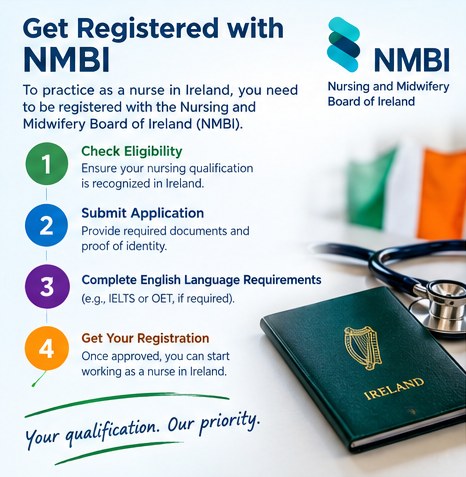
Before you start
The NMBI publishes official checklists for each application type, and requirements can change. This page gives you a practical overview so you can plan, but always download the current official guidance for your route before requesting documents. Requesting documents twice from a university abroad can add weeks or months to your timeline.
Make a folder, physical and digital, for your application. Scan every document in colour at good resolution and name files clearly, for example “Transcript_University_2026.pdf”. Keep a simple log of what you requested, from whom, when and how it was sent.
Core documents
- Nursing qualification certificate. Your degree or diploma that led to registration as a nurse in your home country.
- Detailed transcript. A full record of your programme showing subjects, theory hours and clinical placement hours, ideally broken down by area of practice and year.
- Verification of qualification. A form or letter completed by your university or college confirming your qualification and programme details. This often must be sent directly by the institution.
- Certificate of current professional status (good standing). From every nursing regulator where you are or have been registered, confirming you have no restrictions. This usually goes directly from the regulator to the NMBI.
- Proof of identity. A certified copy of your passport, in line with NMBI certification rules.
- Proof of name change. A marriage certificate or legal document if any document shows a different name.
- English language test results. IELTS Academic or OET results meeting NMBI requirements, if you need them. See our IELTS and OET guide.
- Employment history. Details of your nursing work since qualifying, sometimes supported by letters from employers.
Documents that often cause problems
Transcripts without clinical hours
Many universities issue transcripts that list subjects and grades but not clinical hours. The NMBI needs to see the hours in each area to compare your training. Ask your university specifically for a transcript or supporting letter that breaks down theory and clinical hours.
Good standing from every regulator
If you have been registered in more than one country or state, you need certificates from each. Nurses who worked in the Gulf or the UK, for example, often forget to request certificates from those regulators.
Certified copies
The NMBI has rules about who can certify copies and how. A plain photocopy is not enough. Follow the official instructions exactly.
Translations
Documents not in English usually need certified translations by a qualified translator. Send both the original language document and the translation.
Name differences
Small spelling differences between passport, certificates and transcripts can cause queries. Provide official proof linking the names.
Step-by-step document plan
- Download the current NMBI guidance and checklist for nurses trained outside Ireland.
- Request transcripts and verification forms from your university first, as these take the longest.
- Request certificates of good standing from every regulator you have been registered with.
- Book your English test so the results will still be valid when your file is assessed.
- Prepare certified copies of your passport and any name change documents.
- Arrange certified translations where needed.
- Create your NMBI online account, complete the application and pay the fee.
- Upload your documents and track third-party documents until the NMBI confirms receipt.
Checking your documents before you submit
- Every document shows the same name, or name changes are proven.
- Dates on certificates match your CV and application form.
- Transcripts include theory and clinical hours.
- Good standing certificates are recent and from every regulator.
- English results meet section scores and are within the validity period.
- Certified copies follow NMBI rules.
- Translations are certified and attached to originals.
Tips from nurses who have done it
- Visit your university in person or send a trusted relative if online requests are slow.
- Pay for tracked courier delivery when documents must be posted.
- Keep copies of every courier receipt and email confirmation.
- Respond quickly to any NMBI request for more information.
- Do not send documents the NMBI has not asked for; extra paper can slow assessment.
Frequently asked questions
This checklist is general guidance. The NMBI’s official checklist always takes priority.
Can I upload my own transcript to NMBI?
Some documents can be uploaded by you, but others, such as verification forms and good standing certificates, usually must come directly from the issuing body. Check the official checklist.
How recent must my certificate of good standing be?
The NMBI sets a validity period for these certificates. Request them close to your application date and check current rules.
Do I need to translate my documents?
Documents not in English generally need certified English translations alongside the originals.
What if my university has closed?
Contact the NMBI for guidance. You may need to obtain records from the authority that holds the university’s archives.
Next: understand your timeline
See how long NMBI decisions take and what your letter means.