Nursing Career in Ireland: A Clear Guide for Nurses Moving to Ireland
Your skills. A global future.
Ireland needs nurses, and thousands of internationally trained nurses build careers here every year. This guide walks you through every stage, from checking your qualification and getting registered with the Nursing and Midwifery Board of Ireland (NMBI) to finding a job, getting your work permit and settling into life in a new country.

Why so many nurses choose a nursing career in Ireland
Ireland has one of the youngest populations in Europe, but it is ageing fast, and demand for healthcare keeps growing. Public hospitals, private hospitals, community services and nursing homes all report ongoing staff shortages. For a qualified nurse, that means real job opportunities, employers who are used to supporting international recruits, and a work permit system that treats nursing as a priority profession.
Ireland is also an English-speaking country inside the European Union. You work in English, your children can attend English-language schools, and your experience is respected when you move between countries later in your career. Many nurses from India, the Philippines, Pakistan, Nigeria, Zimbabwe, Kenya and the UK already work in Irish wards, so you will rarely be the only international nurse on your team.
Pay is set by national pay scales in the public sector, with extra payments for nights, weekends and public holidays. You get a pension, paid annual leave and structured training. On top of that, Ireland is safe, friendly and small enough that the sea, the mountains and historic towns are never far away.
That said, moving abroad is a big decision. Housing in Dublin and other cities is expensive, the paperwork takes time and the first months in a new health system can feel hard. This site gives you an honest picture so you can plan properly. Read more in our guide on why choose nursing in Ireland.
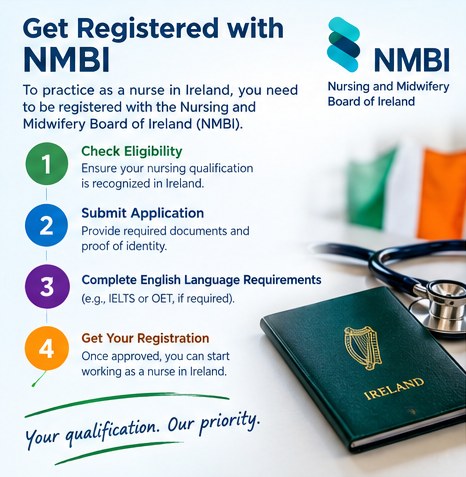
Your path to working as a nurse in Ireland, step by step
Every international nurse follows roughly the same route. The order matters, because each stage depends on the one before it.
- Check your eligibility. You need a nursing qualification recognised in your home country and, in most cases, current registration with your home nursing council.
- Pass an English language test. Nurses trained outside English-speaking countries usually need IELTS Academic or OET at the level the NMBI sets.
- Apply to the NMBI. Submit your application, qualification documents, transcripts and good-standing certificates through the NMBI online portal.
- Receive your decision letter. The NMBI tells you whether you can register directly or must first complete an adaptation programme or an aptitude test.
- Get a job offer and work permit. An Irish employer offers you a role, and you apply for an employment permit, usually the Critical Skills Employment Permit, followed by a visa if your nationality needs one.
- Arrive, complete any adaptation and register. Once you meet all conditions, the NMBI adds you to the register and you can work as a registered nurse.
Each of these steps has its own detailed guide on this site, starting with NMBI registration for overseas nurses. You can also browse all our guides, including country guides, city job guides and free calculators.
NMBI registration: the most important step
You cannot practise as a nurse or midwife in Ireland without being on the NMBI register. The NMBI is the independent regulator for the profession. It checks that your education and training meet Irish and EU standards, and it protects the public by making sure every nurse is safe to practise.
Most applicants start by creating an account on the NMBI online portal and paying the application fee. You then arrange for your documents to be sent, often directly from your university and your home nursing council. These usually include your degree or diploma, a full transcript that shows theory and clinical hours, a certificate of current registration and good standing, proof of identity, and your English test results.
The NMBI compares your training with Irish requirements. If there are gaps, for example fewer clinical hours in a specific area, your decision letter will say you must complete a compensation measure. That is normal, and it is not a rejection. It simply means you need a short period of supervised practice or a test before full registration.
Processing times change throughout the year, so start early and keep copies of everything. Missing or unclear documents are the most common cause of delays.
English tests for nurses: IELTS or OET
If your nursing education was not in English, or you trained in a country the NMBI does not list as exempt, you will need to show your English level. The two accepted options are the IELTS Academic test and the Occupational English Test (OET) for nursing.
IELTS is a general academic test. OET uses real healthcare situations, such as handover notes, patient conversations and referral letters, so many nurses find it more familiar. Both tests have minimum scores for each section, and you must usually reach them in one sitting or within the combinations the NMBI allows. Always check the current minimum scores on the NMBI website before you book, because requirements are updated from time to time.
Our IELTS and OET guide for Ireland explains the differences and how to choose the right test.
Adaptation programme or aptitude test
Many overseas nurses receive a decision letter that asks for a compensation measure. There are two main types.
An adaptation and assessment programme is a period of supervised clinical practice in an approved Irish hospital or healthcare setting. You work under the guidance of experienced nurses while your competence is assessed. Many employers recruit international nurses straight into adaptation places and support them through it.
An aptitude test is an exam that assesses your knowledge and clinical skills against Irish standards. It is usually taken in Ireland, and some nurses choose it because it can be faster than a full adaptation period.
Your decision letter tells you which options apply to you. Read it carefully, note any expiry date and plan your job search around it.
Work permits and visas for nurses
If you are not from the European Economic Area, Switzerland or the UK, you need an employment permit to work in Ireland. Registered nurses are on the Critical Skills Occupations List, which makes the Critical Skills Employment Permit the usual route.
This permit has real advantages. It is tied to occupations that Ireland urgently needs, it allows you to bring your spouse or partner and children, and after a qualifying period of working on the permit, holders can apply for longer-term permission to stay. Spouses and partners of critical skills holders may also be able to work in Ireland without needing their own employment permit.
Your employer usually starts or supports the permit application after you accept a job offer. If your nationality needs a visa to enter Ireland, you apply for an employment visa once the permit is granted. After arrival, you register your immigration permission with the immigration service.
Read the full guide on nurse visa and work permits in Ireland.
Nurse salary in Ireland and benefits
Most nurses in the public health service are paid on HSE consolidated pay scales. A newly registered staff nurse starts at the first point of the scale and moves up one point each year. Starting pay is in the mid-€30,000s per year and rises over time to more than €50,000 before extra payments. Senior staff nurses, clinical nurse managers and advanced practitioners are on higher scales.
Basic pay is only part of the picture. Nurses working nights, weekends, Sundays and public holidays receive premium pay, which can add a noticeable amount to monthly earnings. Public sector roles also include a pension, generous annual leave and paid study leave for approved courses. Private hospitals and nursing homes set their own rates, which can be higher or lower than the HSE scale, so always compare the full package.
See current pay details and take-home examples in our nurse salary in Ireland guide.
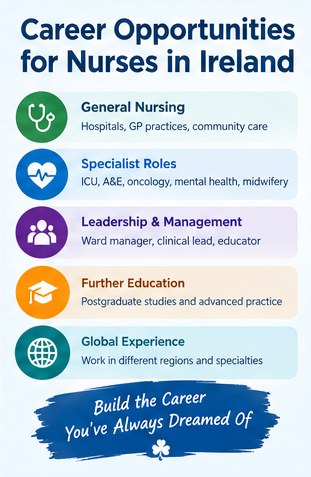
Where nurses work in Ireland
Your first role is often in a hospital ward, but Irish nursing offers far more than that. Common settings include:
- Acute public hospitals run by the HSE and voluntary hospitals
- Private hospitals and day surgery clinics
- Nursing homes and residential care for older people
- Community and public health nursing
- Mental health and intellectual disability services
- GP practices and occupational health
With experience, you can move into specialist areas such as ICU, emergency care, theatres, oncology, renal, paediatrics and midwifery. Leadership roles include clinical nurse manager, clinical nurse specialist and advanced nurse practitioner. Explore every option in nursing career opportunities in Ireland.
Living in Ireland as a nurse
Ireland offers a good quality of life, but it helps to know what to expect. Dublin is the largest job market and the most expensive city for rent. Cork, Galway, Limerick and Waterford have major hospitals and lower living costs, while many towns have regional hospitals and nursing homes that actively recruit.
Public transport is good in cities and limited in rural areas, so some nurses buy a car. Schools are free in the public system, and healthcare is available through the public service. The weather is mild, often rainy and rarely extreme. Communities from Kerala, Manila, Lagos, Lahore and beyond are well established, with churches, temples, mosques, food shops and cultural groups in most cities.
Our work and live in Ireland guide covers housing, cost of living, banking and settling in.

Common mistakes to avoid
Most delays come from a few avoidable problems. Learn from the nurses who went before you.
- Booking the English test too early. Results have a validity period. Time your test so the results are still valid when the NMBI assesses your file.
- Sending incomplete documents. Transcripts without clinical hours or certificates without official stamps lead to requests for more information.
- Paying agents for false promises. No one can guarantee NMBI registration or a permit. Ethical recruiters do not charge nurses large placement fees. Check any agency carefully.
- Ignoring your decision letter deadline. Decision letters can expire. Plan your job search and adaptation in good time.
- Underestimating housing. Ask employers about relocation support and temporary accommodation before you travel.
Frequently asked questions
Can foreign nurses work in Ireland?
Yes. Internationally trained nurses can work in Ireland once they are registered with the NMBI and have the right immigration permission. Many hospitals and nursing homes recruit overseas nurses every year.
How long does it take to become a nurse in Ireland from abroad?
It varies. Gathering documents, passing an English test, NMBI assessment, finding a job, getting a permit and completing adaptation can take anywhere from several months to more than a year. Starting early and sending complete documents makes the biggest difference.
Do I need IELTS to work as a nurse in Ireland?
Most nurses trained in non-English-speaking countries need IELTS Academic or OET. Some applicants who trained and registered in specific English-speaking countries may be exempt. Check the NMBI rules for your situation.
Can I bring my family to Ireland as a nurse?
Nurses on a Critical Skills Employment Permit can usually bring their spouse or partner and children. Spouses may also be able to work. Rules can change, so check the latest guidance from the Irish immigration service.
Is nursing in Ireland well paid?
Public sector nurses are paid on national HSE scales, with premiums for unsocial hours, a pension and good leave. Pay rises each year on the scale and is higher in senior and specialist roles.
Is a nursing career in Ireland worth it?
For many nurses, yes. Ireland offers stable work, career progression, family permits and an English-speaking EU base. The trade-offs are high rents in cities and a process that needs patience.
Nurse today. Leader tomorrow.
Your nursing career in Ireland starts with one step
Check your eligibility, gather your documents and read our NMBI registration guide. When you have questions, contact us and we will point you to the right resource.