Nursing Career Opportunities in Ireland
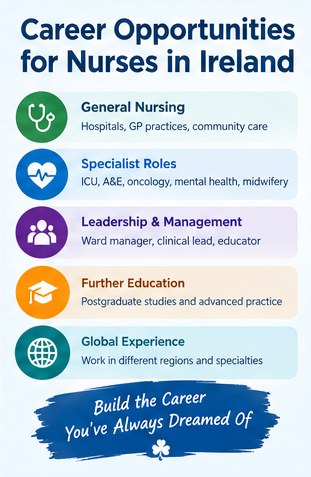
Build the career you’ve always dreamed of.
A staff nurse post is just the beginning. Irish nursing offers specialist roles, leadership positions, education pathways and advanced practice. Here is how careers develop and how to plan your next move.
General nursing
Most international nurses begin in general nursing, working on medical, surgical or mixed wards in acute hospitals, or in nursing homes, GP practices and community care. These roles build core Irish experience: local policies, documentation systems, medication practice and multidisciplinary teamwork. Many nurses spend one to two years in general roles before choosing a specialty.
Specialist clinical areas
Ireland has strong demand for nurses in specialist areas. Each has its own skills, pace and further education options.
- Intensive care (ICU). Caring for critically ill patients with advanced monitoring and ventilation.
- Emergency department (ED). Fast-paced triage and acute care.
- Operating theatres. Scrub, anaesthetic and recovery nursing.
- Oncology and haematology. Chemotherapy, supportive care and specialist cancer services.
- Cardiology, renal and respiratory. Specialist wards and outpatient services.
- Mental health. Inpatient and community services, often requiring registration in the psychiatric division.
- Gerontology. Care of older people across hospitals, community and residential settings.
- Paediatrics and neonatal care. Children’s hospitals and neonatal units.
- Midwifery. Maternity services, for those registered as midwives.
- Palliative care. Hospice and end-of-life care.
Experience you bring from your home country is valued. If you have worked in ICU, theatre or emergency for several years, highlight this in your CV and interviews, as it can open doors to specialist roles sooner.
The Irish nursing career ladder
- Staff nurse. Delivers direct patient care and builds clinical experience.
- Senior staff nurse. Recognises long service and experience on the staff nurse grade.
- Clinical nurse manager 1. Supports ward management and leads shifts.
- Clinical nurse manager 2. Manages a ward or unit, including staffing, budgets and quality.
- Clinical nurse manager 3 and assistant director of nursing. Oversees several units or a service area.
- Director of nursing. Leads nursing across a hospital or service.
Alongside the management ladder, there is a clinical ladder. A clinical nurse specialist (CNS) focuses on one area of practice, such as diabetes, wound care or infection control, and supports patients and colleagues with expert knowledge. An advanced nurse practitioner (ANP) works at an advanced level, often assessing, diagnosing and treating patients and in some cases prescribing, after completing a relevant master’s degree and meeting NMBI standards.
Further education
Irish universities and colleges offer postgraduate certificates, diplomas and master’s degrees in most specialties, often designed for working nurses with part-time study and clinical placements. Popular programmes include critical care, emergency nursing, perioperative nursing, gerontology, mental health and nurse prescribing. Many employers fund courses or provide study leave, especially in specialist areas with shortages.
Continuing professional development (CPD) is also part of everyday practice. Hospitals run in-house training in areas like IV cannulation, venepuncture, medication management and leadership. Building a record of CPD helps with promotion and with your annual registration renewal.
Nurse education and research
Experienced nurses can move into clinical education, teaching new staff and students on the ward, or into academic roles in universities. Research nurses support clinical trials in hospitals and research centres, a growing field in Ireland. These roles usually require postgraduate qualifications and strong clinical experience.
Community and public health roles
Public health nurses provide care in the community, including child health checks, care of older people at home and support after hospital discharge. These roles require registration as a public health nurse, which involves a postgraduate qualification. Community roles also include practice nursing in GP surgeries, home care and community mental health.
Global experience
Irish nursing experience is respected internationally. Some nurses use their time in Ireland as a foundation for later roles elsewhere in Europe or beyond, while others build long-term careers and settle permanently. Either way, the skills, qualifications and references you gain in Ireland travel with you.
Other directions for experienced nurses
Not every nursing career stays at the bedside. With experience, some nurses move into quality and patient safety, infection prevention and control, clinical informatics, bed management, occupational health or nurse recruitment. Others work for the HSE in planning and policy, for pharmaceutical and medical device companies as clinical specialists, or for private healthcare providers in case management. These paths use your clinical knowledge in new ways and often offer regular daytime hours.
What employers look for in promotion interviews
Irish health services use competency-based interviews. Panels ask for real examples of how you led a team, managed a difficult situation, improved quality of care or communicated with a distressed family. Prepare short stories using a simple structure: the situation, what you did and the result. Show that you know national standards and local policies, and that you reflect on your practice. Mentors and senior colleagues are often happy to run practice interviews.
How to plan your career progression
- Spend your first year mastering the basics and building good references.
- Talk to your manager about your goals during performance reviews.
- Shadow nurses in specialties that interest you.
- Keep a professional portfolio of training, certificates and achievements.
- Apply for funded courses when they are advertised.
- Join professional networks and attend conferences.
Frequently asked questions
Can international nurses get promoted in Ireland?
Yes. Promotion is based on experience, qualifications and interview performance, and many international nurses hold manager and specialist roles.
Which nursing specialty is most in demand in Ireland?
Older person care, mental health, intellectual disability, ICU, emergency and theatre nursing are consistently in demand.
How do I become an advanced nurse practitioner in Ireland?
You need significant clinical experience, a relevant master’s degree and to meet NMBI standards for advanced practice, usually within an approved ANP post.
Nurse today. Leader tomorrow.
Start your journey
Every career begins with registration. Read our step-by-step NMBI guide.