NMBI Registration for Overseas Nurses: Step-by-Step Guide
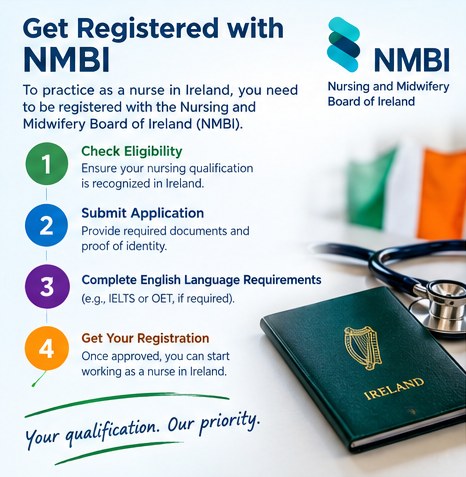
Your qualification. Your priority.
To practise as a nurse in Ireland, you must be registered with the Nursing and Midwifery Board of Ireland (NMBI). This guide explains who the NMBI is, which documents you need, how the assessment works and what your decision letter means.
What is the NMBI?
The Nursing and Midwifery Board of Ireland is the independent, statutory regulator for nurses and midwives in Ireland. It maintains the Register of Nurses and Midwives, sets standards for education and practice, publishes the Code of Professional Conduct and Ethics, and handles complaints about fitness to practise. Its main purpose is to protect the public.
Anyone who wants to use the title “registered nurse” or “registered midwife” in Ireland must be on the NMBI register. Employers check registration before you start, and you renew it every year.
Divisions of the register
The register has separate divisions. You apply to the division that matches your training, for example general nursing, psychiatric nursing, children’s nursing, intellectual disability nursing, midwifery, or public health nursing. Most international nurses apply to the general division. If your training included more than one area, you may be able to apply to more than one division.
The NMBI registration process, step by step
- Check eligibility. Make sure you hold a nursing qualification that leads to registration in your home country, and that you are currently registered and in good standing there, or were when you last practised.
- Meet the English requirement. If you need to show English proficiency, take IELTS Academic or OET and reach the NMBI minimum scores. See our IELTS and OET guide.
- Create your NMBI online account. Register on the NMBI portal, choose the correct application type for nurses trained outside Ireland and pay the application fee.
- Submit your documents. Upload the documents you are responsible for and arrange for third parties, such as your university and nursing council, to send theirs directly where required.
- Assessment. The NMBI compares your education with Irish standards, including theory and clinical hours in each area of practice.
- Decision letter. You receive a decision that either allows registration or sets out compensation measures you must complete first.
- Complete any conditions and register. Finish adaptation or pass the aptitude test, provide any final documents, pay the registration fee and receive your PIN.
Documents you will usually need
Requirements are set by the NMBI and can change, so always use the official checklist for your application type. Typical documents include:
- Your nursing degree or diploma certificate
- A detailed transcript showing subjects, theory hours and clinical placement hours by area
- A verification of qualification form completed by your university or college
- A certificate of current professional status or good standing from each nursing council where you are or were registered
- Proof of identity, such as a certified passport copy
- Proof of name change if your documents show different names
- English language test results, if required
- Details of your work experience since qualifying
Documents not in English usually need certified translations. Some documents must come directly from the issuing body rather than from you. Check every requirement before you request documents, because asking a university twice can add weeks.
Understanding your decision letter
After assessment, the NMBI issues a decision letter. There are three common outcomes:
- Eligible to register. Your training meets requirements and you can complete registration.
- Compensation measures required. There are gaps between your training and Irish standards. You must complete an adaptation and assessment programme or pass an aptitude test before you can register.
- Not eligible. Your qualification does not meet the requirements for the division you applied to. The letter explains the reasons and any right of appeal.
Most overseas nurses receive the second outcome. That is normal and expected. Note any time limit on your decision letter, because you will need to complete the conditions within that period.
Adaptation programme vs aptitude test
Adaptation and assessment is supervised clinical practice in an approved Irish healthcare setting. You work on a ward under the guidance of registered nurses while your competence is assessed against Irish standards. Many employers recruit international nurses specifically into adaptation places, and some pay a salary during this period.
The aptitude test assesses your knowledge and clinical skills through an exam, usually including a written element and a practical clinical skills assessment. It is held in Ireland. Some nurses prefer it because it can be completed in a shorter time, but you need to prepare thoroughly and arrange your own travel and accommodation.
Your decision letter states which options are open to you. Speak to potential employers about which route they support.
How long does NMBI registration take?
Processing times vary with demand and the completeness of your file. The assessment itself can take a few months once all documents arrive, and adaptation adds further weeks. The biggest delays usually come from slow responses by universities or nursing councils, documents that do not match the checklist, and English results that expire. Track every document request and follow up politely but regularly.
Tips for a smooth NMBI application
- Read the official NMBI guidance for your application type before you start.
- Ask your university early for transcripts with clinical hours, as these take the longest.
- Make sure your name is spelled the same on every document, or provide proof of change.
- Keep scanned copies and a log of everything you send, with dates.
- Do not pay third parties who promise faster registration; only the NMBI decides.
Frequently asked questions
Can I apply to NMBI from outside Ireland?
Yes. The application is online, and most applicants complete the assessment stage from their home country.
Do I need a job offer before applying to NMBI?
No. You apply to the NMBI first. A job offer is usually needed later for your employment permit and adaptation placement.
What is an NMBI PIN?
Your PIN is your personal registration number on the NMBI register. Employers use it to confirm you are registered.
Next: secure your work permit
Once you have a job offer, learn how the Critical Skills Employment Permit works for nurses.