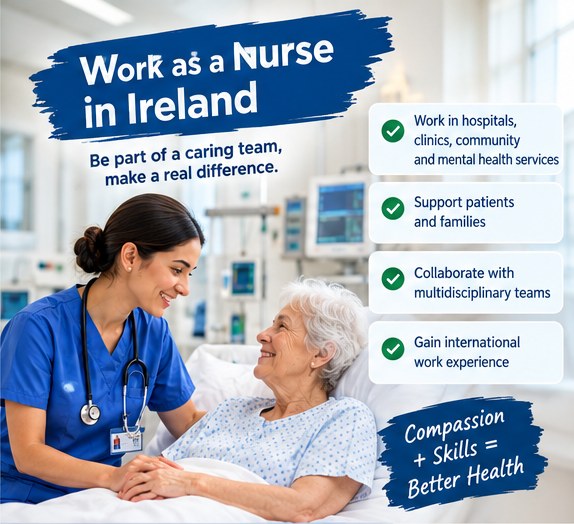
Work as a Nurse in Ireland
Compassion + skills = better health.
What is it really like to work as a nurse in Ireland? This guide covers the roles, shifts, teams, expectations and first months on the job, so you know what to expect before you arrive.
Who can work as a nurse in Ireland
To work as a nurse in Ireland, you must be registered with the Nursing and Midwifery Board of Ireland (NMBI) in the correct division of the register, such as general nursing, children’s nursing, psychiatric nursing, intellectual disability nursing or midwifery. You also need permission to work, which for most non-EEA nurses means a Critical Skills Employment Permit. Until you are fully registered, you may be employed in a supervised role as part of an adaptation programme, but you cannot practise independently as a registered nurse.
Some nurses start as healthcare assistants while waiting for registration. This can give useful experience of the Irish system, but it is a different role on a different permit, and it is important to understand the conditions before accepting.
Where you could work
- Acute hospitals. Medical, surgical, emergency, critical care, theatre and specialist wards in public, voluntary and private hospitals.
- Nursing homes. Long-term and residential care for older people, a large and growing employer of international nurses.
- Community services. Public health nursing, home care, palliative care and primary care teams.
- Mental health services. Inpatient units, community mental health teams and specialist services.
- Intellectual disability services. Residential and community support for people with intellectual disabilities.
- Clinics and practices. GP practices, outpatient clinics, day surgery and occupational health.
Your role on the team
Irish nursing is patient-centred and evidence-based. As a staff nurse, you assess patients, plan and deliver care, give medications, monitor and record observations, and communicate with patients and families. You work closely with doctors, healthcare assistants, physiotherapists, occupational therapists, pharmacists and social workers. Nurses are expected to speak up, ask questions and advocate for patients. This can feel different if you trained in a more hierarchical system, but it is welcomed in Irish wards.
Documentation is detailed, and many hospitals use national early warning scores, care bundles and standard assessment tools. You will be trained on local policies during induction.
Shifts and working hours
The standard full-time week for HSE nurses is 37.5 hours. Many wards use long day shifts of around 12 hours, combined with night shifts, so you might work three or four days a week. Other areas use shorter early and late shifts. Rosters are usually shared several weeks in advance.
Working nights, Saturdays, Sundays and public holidays earns premium pay. Overtime and agency work are also available in many areas, though your permit conditions and wellbeing should guide how much extra you take on.
Your first months: induction and support
Good employers provide a structured induction covering hospital policies, IT systems, medication management, manual handling, infection control and basic life support. International nurses are often given a preceptor or mentor, a senior nurse who supports you on the ward. If you are on an adaptation programme, you will have assessments of your competence over several weeks.
Expect a learning curve. Medication brand names, abbreviations, Irish accents and local slang can take time to get used to. Ask questions freely; colleagues expect it.
Skills Irish employers value
- Clear communication with patients, families and the wider team
- Safe medication management and accurate documentation
- Person-centred care that respects dignity and choice
- Willingness to raise concerns and escalate deteriorating patients
- Teamwork, flexibility and cultural awareness
- Commitment to ongoing learning and professional development
How to find a nursing job in Ireland
The main routes are applying directly to HSE and hospital group recruitment campaigns, applying to private hospitals and nursing home groups, and working with licensed recruitment agencies. Many employers run international recruitment drives and interview online. Prepare a clear CV that lists your clinical areas, years of experience, skills and registration status, and practise answering competency-based interview questions using real examples.
Be careful with agencies. Ethical recruiters are paid by employers, not by nurses. Ask any agency what fees they charge, what they provide and whether they are licensed. Never pay for a guaranteed job or guaranteed registration.
Professional standards and ongoing learning
The NMBI publishes a Code of Professional Conduct and Ethics that every nurse must follow. It sets out principles such as respect for the dignity of the person, professional responsibility, quality of practice, trust and confidentiality, and collaboration. Registered nurses renew their registration each year and are expected to keep their knowledge up to date. Employers provide mandatory training, and you can build further qualifications over time.
A typical long day shift
A long day often starts around 8am with handover from the night team, where you receive a summary of each patient’s condition and plan. You then check observations, give morning medications, help with personal care alongside healthcare assistants and join the doctors’ ward round. The middle of the day brings admissions, discharges, wound care, patient education and family updates. Breaks are scheduled across the team. In the evening you give further medications, update care plans and documentation, and finish with a full handover to the night nurse. Every ward has its own rhythm, but clear handovers and teamwork are constant.
Frequently asked questions
How many hours do nurses work in Ireland?
Full-time HSE nurses work 37.5 hours per week, often as long day or night shifts across three to four days.
Can I work as a nurse in Ireland without NMBI registration?
No. You must be on the NMBI register to practise as a nurse. Before registration, you may work only in supervised adaptation or in non-nursing roles allowed by your permit.
Do Irish hospitals hire international nurses?
Yes. Many public and private hospitals and nursing homes recruit internationally and support nurses through adaptation and permits.
See where your career could go
Explore specialist, leadership and education pathways for nurses in Ireland.